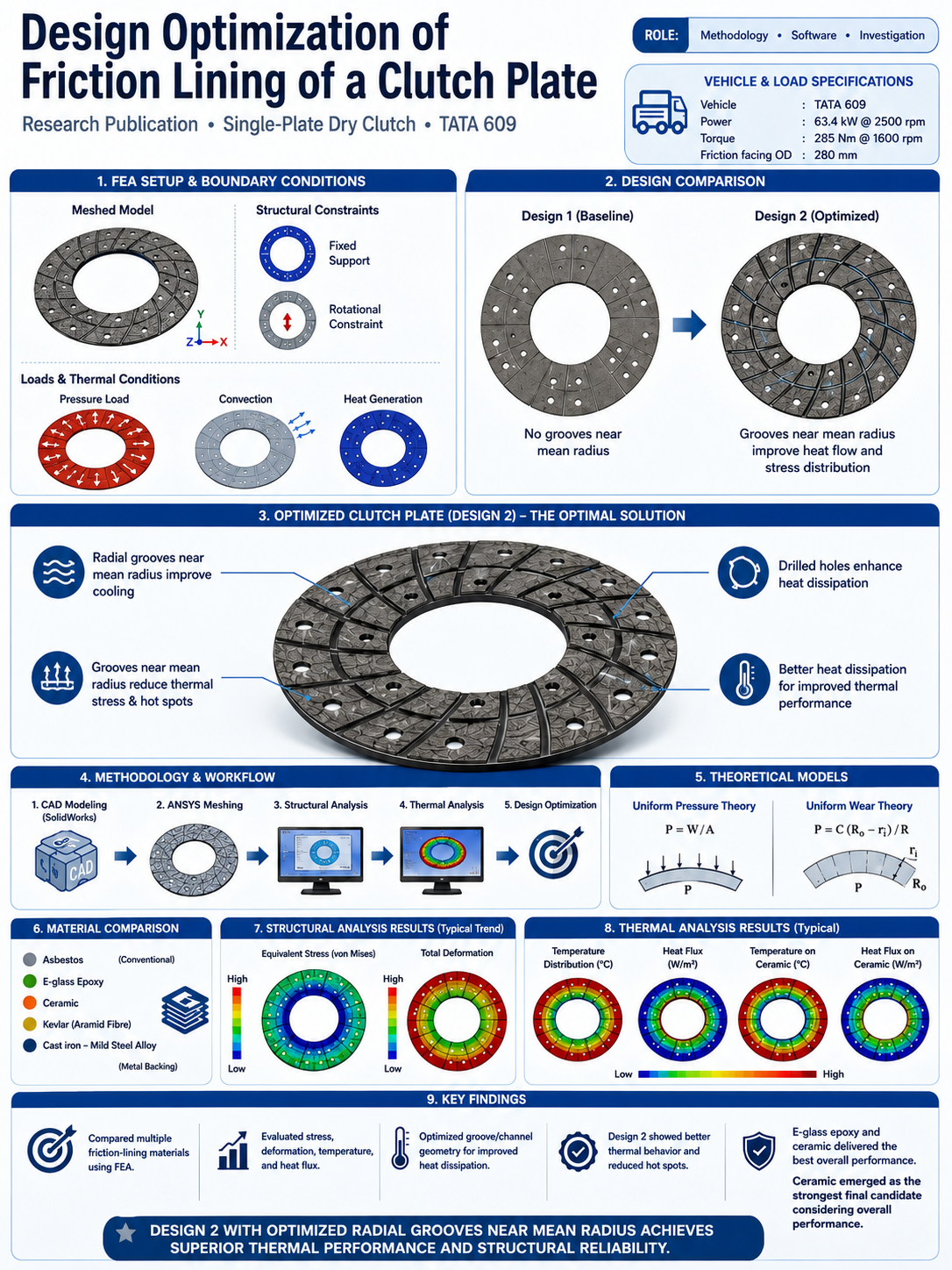
Published in Materials Today: Proceedings by Elsevier, this peer-reviewed research tackled a real engineering problem in automotive powertrains — finding the optimal friction lining material and design for a single plate dry clutch used in the TATA 609 light commercial vehicle. The core challenge was that conventional materials like asbestos and cast-iron alloys generate dangerously high thermal loads during clutch engagement, leading to premature wear and failure. My role, as credited in the paper, covered methodology, software execution, and investigation. I built the CAD models in SolidWorks, ran the full Finite Element Analysis (FEA) in ANSYS across two original friction disc designs and five candidate materials — asbestos, E-glass epoxy, ceramic, Kevlar, and cast-iron alloy — under both uniform pressure and uniform wear theories. The structural and thermal simulations across hundreds of test scenarios identified E-glass epoxy and ceramic as the top performers, with Design 2 reducing peak temperatures by over 65% compared to Design 1 through strategic groove placement near the mean radius for improved heat convection.